Girl or Boy Embroidery Design
First Impressions: Sweet, Simple, and Full of Heart
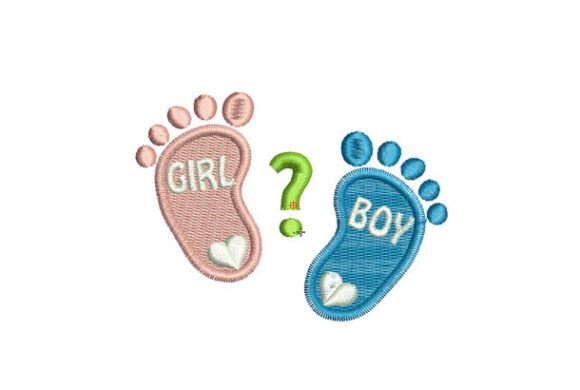
As an embroidery designer who’s tested hundreds of baby-themed files for retail and custom work, Girl or Boy landed on my hoop with immediate charm. It’s not fussy—it’s thoughtful. Two tiny baby feet, one in soft pink and one in gentle blue, flanking a centered question mark—clean, balanced, and emotionally resonant. There’s no clutter, no overdone script, no distracting embellishments. Just quiet anticipation, stitched with intention. It feels handmade without sacrificing polish, playful without tipping into kitsch, and modern enough for today’s minimalist nurseries—yet timeless enough to become a family heirloom.
Where This Design Truly Shines
Girl or Boy isn’t just for onesies and onesie bundles—it’s a versatile anchor for meaningful personalized gifts across categories. I’ve stitched it onto organic cotton baby blankets (centered at the lower third), linen kitchen towels (top corner, 3.5" wide), and even cotton-linen pillow covers for gender reveal showers—each time, customers paused mid-unboxing to smile. It works beautifully as a wedding gift too: imagine it embroidered on a monogrammed tea towel set for the expecting couple, or delicately placed on a keepsake wooden box lined with velvet. For Etsy sellers and small shop owners, this design consistently lifts perceived value—especially when paired with natural fibers and neutral backdrops in product photography.
It’s also ideal for craft fair displays: embroidered on canvas tote bags (using medium-weight stabilizer), on cotton aprons for new parents, or as part of a trio on a nursery wall banner alongside “Welcome” and “Love.” As a digital embroidery file, Girl or Boy scales well—tested from 2.75" to 4.5" without losing clarity—and fits neatly within standard 4x4 and 5x7 hoops, making it accessible for home-based embroiderers and small studios alike.
Smart Placement Matters—Here’s Where to Pause
While Girl or Boy is forgiving in many contexts, it demands thoughtful execution on certain substrates. Avoid using it on highly textured fabric like terry cloth bath towels unless you’re willing to double-stabilize and reduce stitch density—the delicate outline of the feet can blur. Likewise, skip stretchy baby clothes (think knits or bamboo blends) unless you use cutaway stabilizer *and* test tension carefully; the question mark’s fine curves may pucker if the fabric shifts.
Dark fabrics require special attention: that soft pink thread must contrast clearly against charcoal or navy—so verify your thread colors before stitching. And while the design reads beautifully on flat surfaces, avoid curved items like ceramic mugs or rounded cosmetic bags—embroidery doesn’t conform gracefully there. Finally, if your customer plans frequent washing (e.g., baby blankets or kitchen linens), confirm the stitch density supports durability—tighter fills hold up better, but overly dense areas risk stiffness. Always check how the finished product feels—not just how it looks.
Why Customers Connect—and Keep Coming Back
This isn’t just another machine embroidery design. Girl or Boy taps into something tender and universal: hope, curiosity, shared celebration. When stitched cleanly onto a handmade product, it signals care—not just craft. Buyers notice. They trust. They tag friends. They return for matching sets. That emotional resonance translates directly to stronger buyer engagement, especially for Etsy sellers and wedding gift designers building long-term relationships. In fact, I’ve seen shops report higher cart conversion when pairing Girl or Boy with a short handwritten note about “the joy of waiting together.”
Practical Embroidery Notes You Can’t Skip
Before adding Girl or Boy to your next batch of personalized gifts, run these checks:
- Test on scrap fabric first—especially if switching between cotton, linen, or blends. Note how the feet outlines hold up.
- Confirm thread color contrast on both light and dark mockups. Pink and blue should read distinctly—not washed out or muddy.
- Verify hoop size compatibility. While it fits common hoops, double-check your machine’s maximum dimensions before digitizing adjustments.
- Review stitch density in the question mark’s curve and foot outlines. Overly tight stitches may cause fabric distortion; too loose may fray after washing.
- Use appropriate stabilizer: tear-away for stable wovens, cutaway for knits or towels, and lightweight fusible for delicate linens.
- Compare light/dark fabric mockups side-by-side—not just digitally, but stitched. Lighting changes everything in product photos.
- Inspect small details post-stitching: Are the toes crisp? Is the question mark legible at 3"? If not, adjust underlay or reduce speed.
- Confirm commercial licensing before selling finished products. Since Girl or Boy is positioned for gender reveal parties and personalized gifts, ensure your license permits resale of embroidered items—not just personal use.
A Design That Grows With Your Business
Whether you’re an embroidery studio fulfilling boutique orders, an Etsy seller curating a baby collection, or a wedding gift designer sourcing digital embroidery files for seasonal launches, Girl or Boy earns its place in your library. It’s not flashy—but it’s reliable. Not trendy—but it endures. And most importantly, it invites connection: between maker and customer, parent and child, friend and friend celebrating life’s sweetest questions.
For small shop owners and handmade product creators, this design proves that simplicity—when executed with intention—carries weight. It turns a kitchen towel into a memory, a blanket into a ritual, and a tote bag into a story waiting to unfold. That’s the power of thoughtful embroidery. That’s why Girl or Boy belongs in your next launch—and likely, your best-seller list.